
How to Care for a Rubber Plant Indoors
Rubber Plant, or Ficus elastica, is a striking indoor plant with large, glossy leaves and an upright tree-like form. With bright indirect light, careful watering, occasional pruning, and good drainage, it can grow into an impressive statement plant for living rooms, offices, and bright indoor corners.
Meet the Plant
Why Grow a Rubber Plant Indoors?
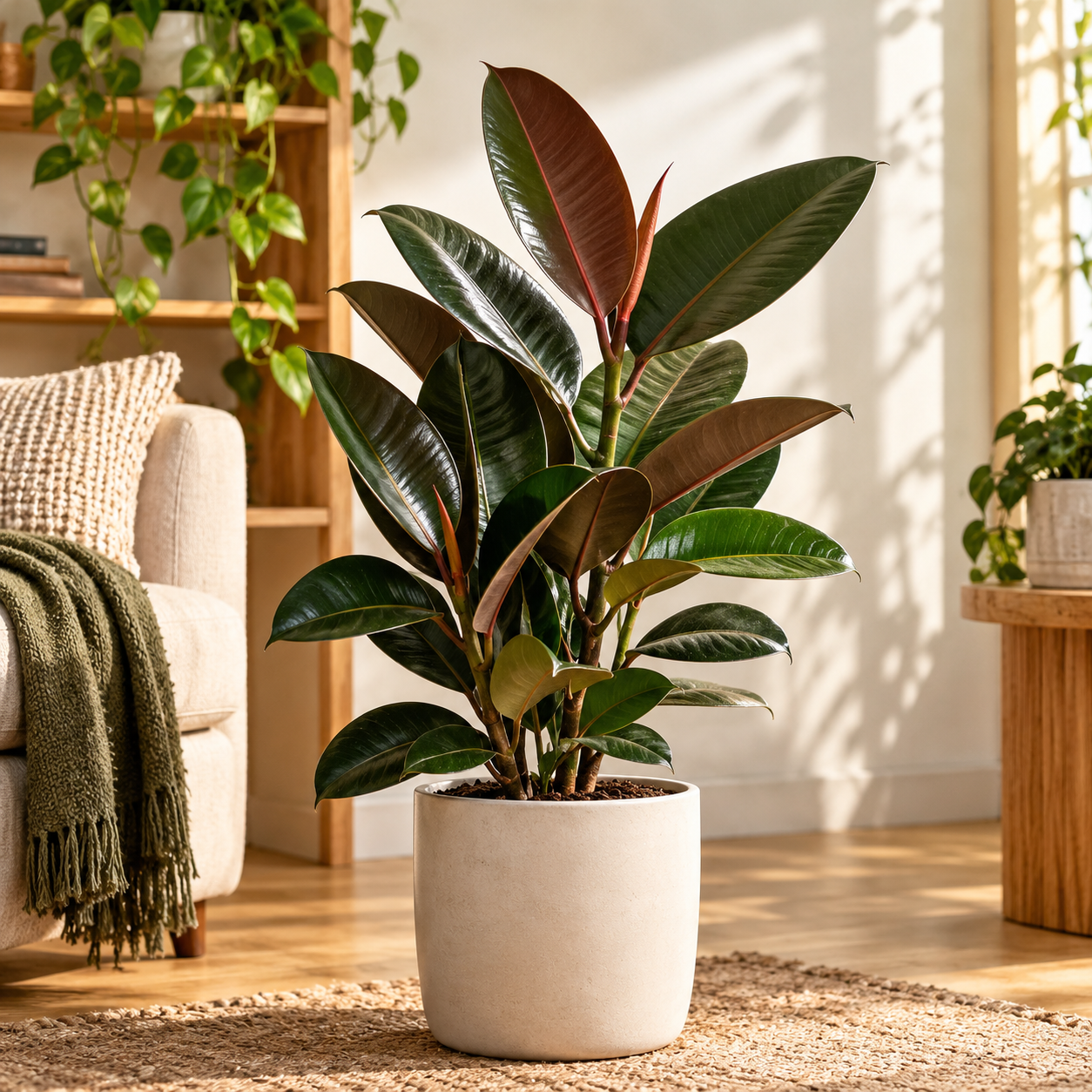
Rubber Plant is one of the most attractive indoor Ficus species. Its thick, glossy leaves create a bold architectural look, while its upright growth allows it to become a beautiful indoor tree over time.
Ficus elastica is available in several forms, including deep green, burgundy, and variegated varieties. Although their coloring differs, the basic care requirements are very similar.
Once established in a good location, Rubber Plant is relatively straightforward to maintain. The biggest mistakes usually involve too much water, too little light, or frequent environmental changes.
Avoid moving the plant repeatedly between very different light, temperature, or watering conditions.
Rubber Plant Quick Care Guide
Start with these basic conditions for healthy Ficus elastica growth.
Light
Bright indirect light produces the strongest growth.
Water
Let the upper soil dry before watering again.
Soil
Use loose, well-draining indoor potting soil.
Humidity
Average indoor humidity is generally suitable.
Temperature
Warm and stable indoor conditions are ideal.
Pruning
Pruning can encourage branching and control height.
Light
How Much Light Does a Rubber Plant Need?
Rubber Plant performs best in bright indirect light. A location near a bright window is ideal, especially when the light is filtered during the hottest part of the day.
Some gentle morning sun can usually be tolerated, but harsh afternoon sunlight may scorch the leaves.
Signs It May Need More Light
- Growth becomes slow.
- New leaves become smaller.
- The plant leans strongly toward the window.
- Large spaces appear between leaves.
- Variegated varieties lose some contrast.
Turning the plant every few weeks can help encourage more balanced growth rather than having all the leaves face one direction.
Watering
How Often Should You Water a Rubber Plant?
Rubber Plants prefer to dry slightly between waterings. They generally tolerate a little dryness better than constantly wet soil.
Avoid watering according to a fixed calendar. Soil may dry quickly in summer but remain moist much longer during winter.
Check the Soil First
Allow the upper 3–5 cm of soil to dry before watering thoroughly.
How to Water Properly
-
1
Feel the upper soil with your finger.
-
2
Water slowly and evenly around the pot.
-
3
Allow excess water to drain from the bottom.
-
4
Empty standing water from the saucer or decorative planter.
💧 Too Dry
- Leaves may droop slightly
- Leaf edges may become dry
- Soil becomes very dry
- Older leaves may fall
⚠️ Too Wet
- Yellow leaves appear
- Leaves may drop
- Soil stays wet for many days
- Roots may begin to rot
Soil & Pot
Best Soil for Rubber Plant
Ficus elastica prefers a loose potting mix that drains well while still holding enough moisture to prevent the roots from drying immediately.
Potting Soil
Provides nutrients and moderate moisture retention.
Perlite
Improves drainage and airflow around roots.
Bark
Adds structure and prevents soil from becoming too dense.
Rubber Plant roots should never remain permanently submerged in standing water.
Humidity
Does Rubber Plant Need High Humidity?
Rubber Plant usually adapts well to average household humidity.
Very dry air can contribute to brown edges, particularly during winter when heating systems are running.
Average Humidity
Normal household conditions are usually suitable.
Group Plants
Grouping plants can slightly improve local humidity.
Avoid Radiators
Hot dry air may damage leaf edges.
Temperature
Best Temperature for Rubber Plant
Ficus elastica prefers warm, stable household temperatures.
Comfortable indoor growing conditions
Protect from cold drafts and sudden temperature changes
Avoid placing it beside frequently opened winter doors, cold windows, or strong heating vents.
Feeding
How to Fertilize a Rubber Plant
During spring and summer, use a balanced liquid houseplant fertilizer occasionally while the plant is actively growing.
Reduce feeding during autumn and winter if growth slows.
Excess fertilizer can lead to salt buildup, root stress, and brown leaf edges.
How to Make a Rubber Plant Bushier
Rubber Plants naturally tend to grow upward on a dominant central stem. Pruning can encourage the plant to develop additional branches.
Increase Light
Bright indirect light supports denser and stronger growth.
Prune the Main Stem
Cutting the growing tip can encourage buds below the cut.
Rotate Regularly
Balanced light helps maintain a more even shape.
Be Patient
New branches may take time to develop after pruning.
Branching
How to Encourage Rubber Plant Branching
If your Rubber Plant grows as one tall stem, pruning the active growing tip can encourage dormant buds lower on the stem to begin growing.
Spring and early summer are usually the easiest times to prune because the plant is actively growing.
Where Should You Cut?
Make a clean cut just above a leaf node at the height where you want the plant to begin branching.
New shoots may eventually develop from nodes below the cut.
Wear gloves and protect furniture or flooring while pruning because the latex-like sap can irritate skin and may stain surfaces.
Pruning
How to Prune a Rubber Plant
Pruning helps control height, improve shape, and encourage branching.
- Remove damaged or diseased leaves.
- Shorten overly tall stems.
- Remove weak or awkward branches.
- Cut above a healthy node when encouraging branching.
Clean tools reduce the risk of transferring disease between plants.
Repotting
When Should You Repot a Rubber Plant?
Repot when the roots clearly need additional space rather than moving the plant to a larger pot simply because another year has passed.
Signs It May Need Repotting
- Roots grow heavily through drainage holes.
- The root ball has become tightly packed.
- The plant dries much faster than before.
- The plant becomes unstable in its container.
- The potting mix has become compacted.
An oversized container can hold excess moisture around the roots.
How to Propagate a Rubber Plant
Healthy stem cuttings can be used to propagate Ficus elastica.
Choose a Healthy Stem
Select a strong section with at least one healthy node.
Make a Clean Cut
Cut below a node using clean pruning shears.
Remove Lower Leaves
Leave enough stem exposed for rooting.
Root the Cutting
Place the cutting in a suitable propagation medium and keep it warm.
Provide Bright Indirect Light
Avoid strong direct sun while the cutting develops roots.
Rubber Plant sap can irritate sensitive skin.
How to Clean Rubber Plant Leaves
The broad leaves can collect dust over time. Keeping them clean helps maintain their glossy appearance and allows more light to reach the leaf surface.
Support the Leaf
Hold the leaf gently from underneath.
Use a Soft Damp Cloth
Wipe from the base toward the tip.
Clean Both Sides
Dust and pests may hide underneath leaves too.
Avoid heavy leaf-shine products. Plain water and a soft cloth are usually enough.
Drooping
Why Are My Rubber Plant Leaves Drooping?
Dry Soil
Very dry roots can cause leaves to lose firmness.
Overwatering
Damaged roots may also cause drooping.
Cold Stress
Sudden cold can cause foliage to decline.
Root Stress
Recent repotting or damaged roots can affect leaf posture.
Yellow Leaves
Why Are Rubber Plant Leaves Turning Yellow?
One older leaf occasionally turning yellow may be normal, but widespread yellowing usually suggests a care problem.
Overwatering
Constantly wet soil can damage the roots.
Poor Drainage
Dense soil may remain wet for too long.
Low Light
Low light slows growth and water use.
Natural Aging
Older lower leaves eventually decline.
Brown Edges
Why Does My Rubber Plant Have Brown Leaf Edges?
- The soil may be drying excessively.
- Indoor air may be very dry.
- The plant may be receiving hot direct sun.
- Fertilizer salts may have accumulated.
- Cold damage may have affected the leaf tissue.
Why Is My Rubber Plant Dropping Leaves?
Ficus elastica may drop leaves when its environment changes suddenly or when the root system is stressed.
Watering Changes
Both drought and overly wet soil can trigger leaf loss.
Temperature Changes
Cold drafts can cause sudden leaf drop.
Low Light
A dark location can lead to weaker growth.
Recent Move
Changing locations may temporarily stress the plant.
Curling Leaves
Why Are Rubber Plant Leaves Curling?
- Check whether the soil is extremely dry.
- Look for strong heat or sun exposure.
- Check for cold drafts.
- Inspect for pests.
- Review recent watering changes.
Slow Growth
Why Is My Rubber Plant Not Growing?
Rubber Plant naturally grows more slowly during darker winter months, but consistently poor growth may indicate that conditions need improvement.
- Increase bright indirect light.
- Check whether the roots are overcrowded.
- Review watering habits.
- Feed gently during active growth.
- Keep the plant warm.
How to Recognize Rubber Plant Root Rot
Yellow Leaves
Several leaves may yellow at once.
Leaf Drop
Leaves may fall despite wet soil.
Wet Soil
The pot may remain saturated for many days.
Soft Roots
Damaged roots may appear dark, soft, or unhealthy.
Common Rubber Plant Pests
Spider Mites
Look for fine webbing and pale leaf speckles.
Mealybugs
Look for cotton-like white clusters.
Scale
Check stems and leaves for small attached bumps.
Check both sides of the foliage whenever you clean the plant.
Rubber Plant Care Through the Seasons
Spring
Growth increases. Spring is ideal for pruning, repotting, propagation, and restarting fertilizer.
Summer
Monitor moisture more frequently and protect leaves from harsh sun.
Autumn
Reduce fertilizer gradually as daylight and growth decrease.
Winter
Give it bright light, water less frequently, and protect it from cold drafts.
Rubber Plant Care Do’s & Don’ts
Do
- Give it bright indirect light.
- Let the upper soil dry before watering.
- Use a pot with drainage holes.
- Rotate the plant occasionally.
- Clean dusty leaves.
- Prune to encourage branching.
- Inspect regularly for pests.
Don’t
- Don’t keep the soil permanently wet.
- Don’t expose it suddenly to harsh midday sun.
- Don’t move it repeatedly between very different locations.
- Don’t overfertilize.
- Don’t use a much larger pot unnecessarily.
- Don’t prune without protecting yourself from the sap.
- Don’t allow pets to chew the leaves.
Is Rubber Plant Safe for Cats and Dogs?
Rubber Plant is not considered a pet-safe houseplant. The milky sap can irritate the mouth, skin, and digestive system.
Keep Ficus elastica somewhere pets cannot chew the leaves or stems. If your pet eats part of the plant and develops symptoms, contact your veterinarian.
Love the Rubber Plant?
Ficus elastica is a beautiful choice if you want a bold indoor plant with large glossy leaves and a tree-like shape.
Plant size, price, availability, and shipping may change. Check the seller’s current listing before purchasing.
Rubber Plant Care FAQs
Is Rubber Plant easy to care for?
Yes. Rubber Plant is relatively manageable when given bright indirect light, good drainage, warm temperatures, and careful watering.
How often should I water a Rubber Plant?
Check the soil rather than following a fixed schedule. Water when the upper few centimeters have dried.
Why is my Rubber Plant dropping leaves?
Leaf drop can result from watering problems, low light, cold drafts, root stress, or a sudden change in location.
How do I make my Rubber Plant bushier?
Give it bright indirect light and prune the growing tip above a healthy node to encourage branching.
Can Rubber Plant grow in low light?
It may tolerate somewhat lower light, but growth is usually slower and less compact. Bright indirect light is preferable.
How do you propagate Rubber Plant?
Healthy stem cuttings containing at least one node can be rooted to produce a new plant.
Why are my Rubber Plant leaves turning yellow?
Yellow leaves can be caused by overwatering, poor drainage, low light, root stress, or natural aging.
Should I clean Rubber Plant leaves?
Yes. Wiping the broad leaves with a soft damp cloth removes dust and makes it easier to inspect the plant for pests.
Is Rubber Plant safe for pets?
No. Keep Rubber Plant away from pets that may chew the leaves or stems because the sap can cause irritation.
Bright Light + Good Drainage + Careful Watering
Rubber Plant can become one of the most impressive plants in your indoor collection without needing constant attention.
Give it bright indirect light, let the upper soil dry before watering, clean the broad leaves occasionally, and prune when you want to encourage branching.
With consistent care, Ficus elastica can grow from a small houseplant into a beautiful indoor tree with large glossy foliage.